- Your cart is empty
- Continue Shopping

$90.00
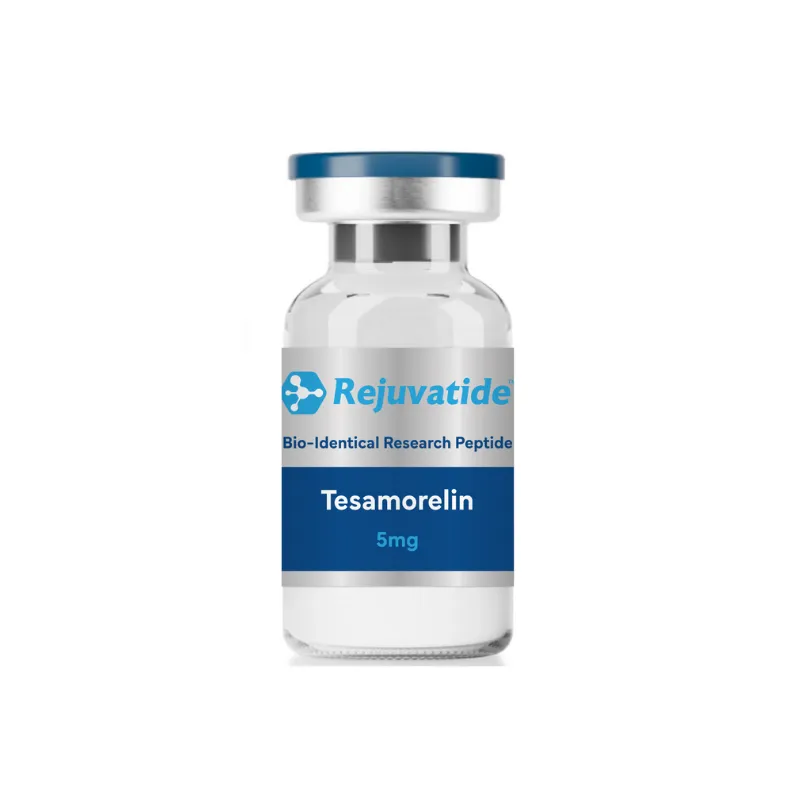
Tesamorelin is an analog of growth hormone-releasing hormone (GHRH). By stimulating the pituitary gland to release more enodgenous growth hormone (GH), tesamorelin increases levels of insulin-like growth factor. Once released, GH acts on multiple tissues including the liver, adipose tissue, and muscle. Through these combined pathways, tesamorelin helps reduce visceral fat, improve body composition and support metabolic regulation.
8 in stock
Tesamorelin is a synthetic analog of human growth hormone-releasing hormone (GHRH) consisting of 44 amino acids with specific N-terminal and C-terminal modifications to enhance stability and biological activity [1]. The peptide’s chemical designation is N-(trans-3-hexenoyl)-[Tyr1]hGRF(1–44)NH₂ acetate, with a molecular formula of C₂₂₁H₃₆₆N₇₂O₆₇S and molecular weight of approximately 5,136 Daltons [2]. As a research tool, tesamorelin has been extensively studied in animal models and clinical trials for its effects on growth hormone secretion, adipose tissue metabolism, and body composition parameters. The pharmaceutical version (Egrifta) received FDA approval in 2010 for reduction of excess visceral adipose tissue in HIV-infected patients with lipodystrophy [3], providing a substantial body of clinical data for researchers studying GHRH biology and metabolic regulation.
Preclinical studies in rodent models demonstrated that GHRH analogs stimulate pituitary somatotroph cells to increase GH secretion, leading to downstream effects on lipolysis, protein synthesis, and metabolic regulation [4,5]. Animal research showed that sustained GH elevation through GHRH analog administration resulted in preferential reduction of visceral versus subcutaneous adipose depots [6]. In vitro studies using pituitary cell cultures demonstrated that tesamorelin activates GHRH receptors with high affinity, triggering intracellular signaling cascades involving cAMP production and protein kinase A activation [7,8]. These cellular models have been valuable for understanding receptor pharmacology and downstream signaling mechanisms.
Lipodystrophy Studies: Two pivotal Phase III clinical trials enrolled 806 HIV-positive subjects with abdominal lipodystrophy and evaluated tesamorelin versus placebo over 26 weeks [9,10]. Results demonstrated a 15.4% mean reduction in visceral adipose tissue (VAT) measured by CT imaging at the L4-L5 vertebral level in tesamorelin groups compared to minimal change in placebo groups. Approximately 30% of subjects achieved reductions of 8% or greater in VAT [9,10]. Tesamorelin-treated subjects showed significant improvements in triglyceride levels (mean reduction of approximately 30 mg/dL) and total cholesterol compared to placebo [9,10]. These metabolic improvements occurred alongside VAT reduction, providing insights into the relationship between visceral adiposity and cardiometabolic markers. Non-Alcoholic Fatty Liver Disease (NAFLD): A 12-month study in 61 HIV-positive subjects examined tesamorelin’s effects on hepatic fat content measured by magnetic resonance spectroscopy [11]. Results showed that 35% of tesamorelin-treated subjects achieved hepatic fat fraction reduction below 5%, compared to minimal changes in placebo groups, suggesting potential applications in hepatic metabolism research. Cognitive Function Research: Exploratory research in 100 HIV-positive subjects examined tesamorelin’s effects on cognitive performance measures over 6-12 months [12]. While preliminary, results indicated potential modest improvements in certain cognitive domains, hypothesized to relate to GH/IGF-1 effects on neurological function. Body Composition Analysis: CT scan analyses from clinical trials revealed that tesamorelin not only reduced visceral fat but also increased muscle density in specific muscle groups including rectus abdominis, psoas major, and paraspinal muscles [13]. These changes suggested improvements in muscle tissue quality, with reduced intramuscular fat infiltration accompanying visceral fat reduction. Growth Hormone Dynamics: Clinical pharmacodynamic studies demonstrated that tesamorelin 2mg daily administration increased mean GH area under the curve (AUC) by approximately 69%, increased mean GH pulse area by 55%, and elevated IGF-1 levels by 122% from baseline [14]. These measurements have been valuable for understanding dose-response relationships in GHRH analog research.
Clinical trial data revealed adverse effects including injection site reactions (approximately 30% of subjects), arthralgias (13-15%), peripheral edema, and myalgias [9,10]. Tesamorelin increases IGF-1 levels and may affect glucose metabolism, with some subjects experiencing alterations in glucose tolerance [15]. The pharmaceutical version is contraindicated in active malignancy, pregnancy, and hypersensitivity reactions [3,16]. These clinical findings provide important safety context for researchers designing studies involving GHRH analogs.
Clinical research has characterized tesamorelin’s effects on endogenous GH secretion patterns. Unlike continuous GH exposure, tesamorelin stimulates pulsatile GH release that maintains physiological rhythms [17]. This preservation of natural secretory patterns has been valuable for comparing physiological versus pharmacological GH administration in research models.
Animal and human studies have explored mechanisms underlying preferential visceral fat reduction. Research indicates that visceral adipocytes express higher levels of GH receptors compared to subcutaneous fat depots, potentially explaining tissue-selective lipolysis [18,19]. Some subjects in clinical trials achieved up to 25% reduction in VAT with sustained treatment [9,10].
Clinical investigations documented improvements in lipid profiles, with significant reductions in triglycerides and trends toward improved cholesterol parameters [9,10]. These effects likely result from GH’s influence on hepatic lipid metabolism and enhanced fatty acid oxidation, providing insights into GH’s metabolic regulatory functions.
Quantitative CT analyses revealed increased muscle attenuation (density) in tesamorelin-treated subjects, indicating reduced intramuscular fat content [13]. These changes occurred alongside modest improvements in lean body mass, offering research opportunities in age-related muscle quality decline and sarcopenic obesity.
Research exploring tesamorelin’s effects on hepatic fat accumulation demonstrated significant reductions in hepatic fat fraction in subsets of subjects [11]. These findings have generated interest in studying GHRH analogs in non-alcoholic fatty liver disease models and hepatic lipid metabolism.
Emerging preclinical research has explored GH/IGF-1’s role in peripheral nerve regeneration and repair [20]. While human data remains limited, animal models suggest potential applications in studying neuroprotective mechanisms and nerve healing processes.
Preliminary clinical research examined relationships between GH/IGF-1 elevation and cognitive performance measures [12]. While mechanisms remain under investigation, hypotheses involve GH/IGF-1’s effects on neuronal metabolism, synaptic plasticity, and neuroprotection.
Tesamorelin is a 44-amino acid synthetic peptide with the sequence: Tyr-D-Ala-Asp-Ala-Ile-Phe-Thr-Gln-Ser-Tyr-Arg-Lys-Val-Leu-Gly-Gln-Leu-Ser-Ala-Arg-Lys-Leu-Leu-Gln-Asp-Ile-Met-Ser-Arg-Gln-Gln-Gly-Gly-Ser-Asn-Gln-Glu-Lys-Val-Leu-Gly-Gln-Leu-Ser-Ala-Arg-Lys-Leu-Leu-Gln-Asp-Ile-Met-Ser-NH₂ [1,2]. The peptide incorporates two critical structural modifications distinguishing it from endogenous human GHRH: N-terminal Modification: Acetylation with a CH₃CO- group at the N-terminus enhances stability against aminopeptidase degradation and improves biological activity [1,2]. C-terminal Modification: Addition of trans-3-hexenoic acid (an omega-amino acid modification) at the C-terminus significantly increases resistance to dipeptidyl peptidase-IV (DPP-IV) and other proteolytic enzymes that rapidly degrade natural GHRH [1,2]. These modifications extend tesamorelin’s plasma half-life to approximately 26-38 minutes following subcutaneous injection, compared to less than 10 minutes for unmodified GHRH [21]. This enhanced stability enables more practical experimental protocols in research settings.
The trans-3-hexenoic acid modification represents a key innovation in peptide stabilization. Natural GHRH is rapidly cleaved by DPP-IV at the N-terminal region, resulting in biological inactivation [22]. By adding a lipophilic side chain, tesamorelin achieves steric hindrance that protects against enzymatic attack while maintaining receptor binding affinity [1,2]. Alternative name designations include (3E)-hex-3-enoylsomatoliberin, reflecting the chemical nature of the hexenoic acid modification. This nomenclature is important for literature searches and chemical database queries in research applications.

Reviews
There are no reviews yet.