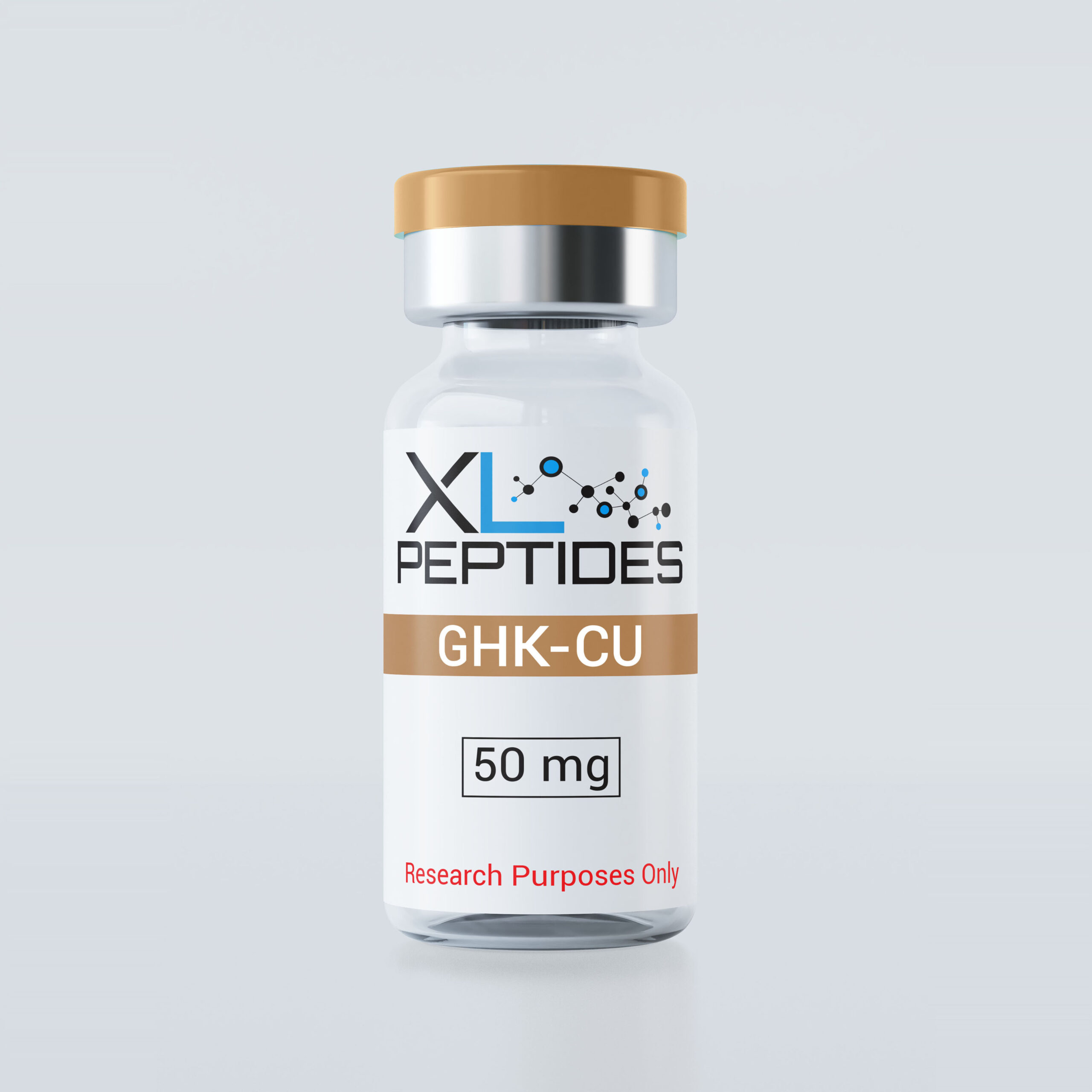
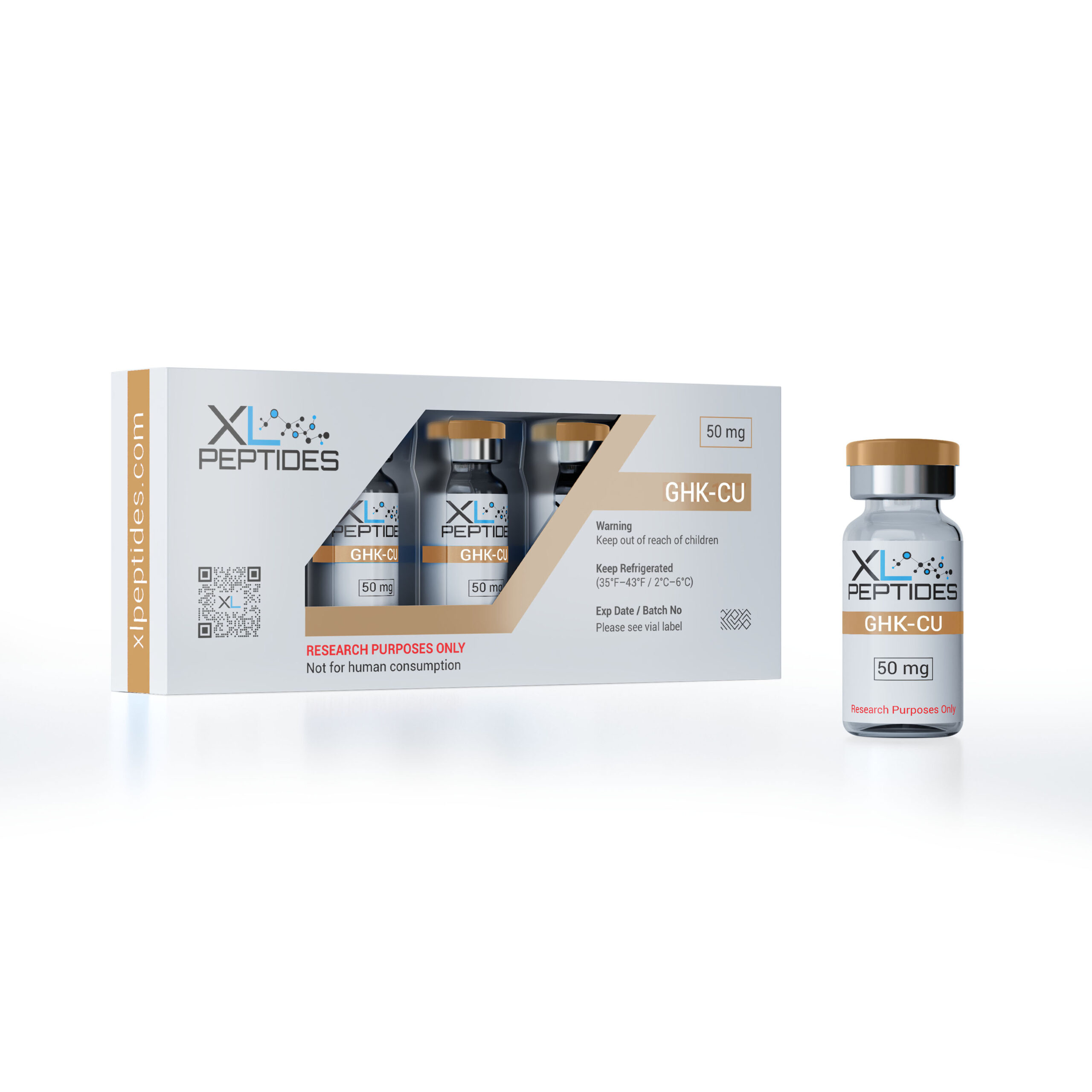
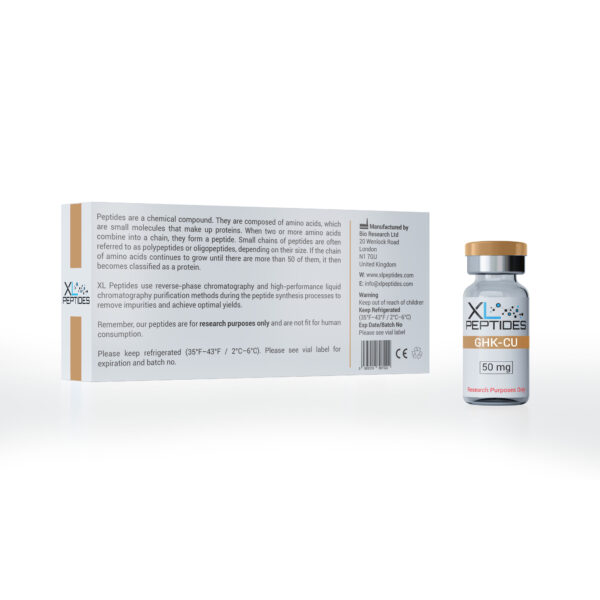
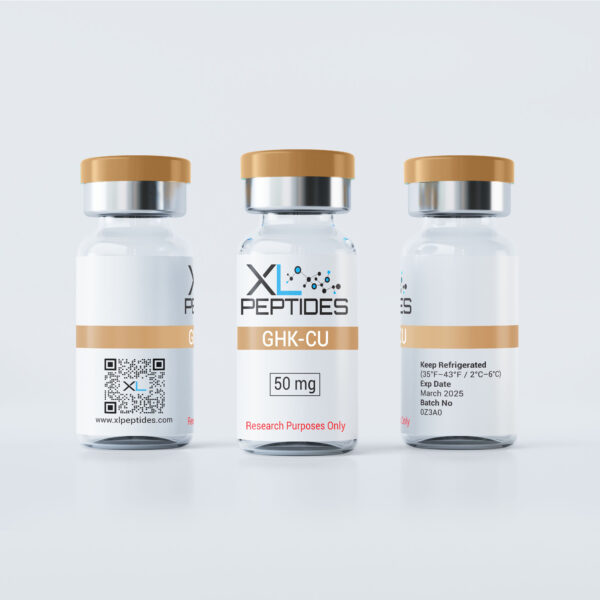
GHK-CU (also written as GHK-Cu) is a copper(II) complex of the tripeptide Gly–His–Lys used in controlled in-vitro studies of extracellular-matrix signalling, collagen pathways, and cell-surface interactions under non-clinical laboratory conditions.
GHK-Cu (Copper Tripeptide)
This complex forms when the tripeptide GHK chelates Cu(II). Because of its coordination chemistry and peptide motif, researchers employ it to probe matrix-associated readouts, peptide–metal interactions, and receptor-adjacent signalling in model systems.
For laboratory research only. Not for human use.
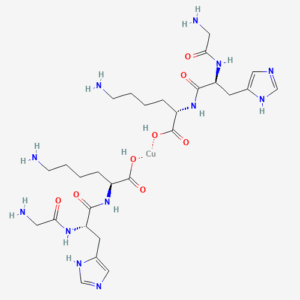
GHK-Cu Key features
- Copper(II) complex of Gly–His–Lys (GHK) for in-vitro ECM/collagen-pathway investigations.
- Supplied as a lyophilised solid for stability and straightforward storage.
- Unit size: 50 mg per vial.
- Each batch released only after stringent quality checks.
Specifications

- Product name: GHK-Cu (Copper tripeptide)
- Synonyms: Copper peptide; Cu-GHK; Tripeptide-1 copper; Prezatide copper
- Peptide component (GHK) sequence: Gly–His–Lys
- Complex formula (reference): C14H24CuN6O4
- Approx. molecular weight (complex, reference): ~401–404 g/mol (varies by counter-ion/hydration)
- CAS (commonly reported): 49557-75-7 (complex); 89030-95-5 (TFA salt)
- Form: Lyophilised powder
- Appearance: Blue to blue-green solid
- Note: Identity and exact values can vary with salt form/counter-ion and hydration.
Handling & storage
- Storage (dry): Keep vials protected from light and moisture.
- Reconstitution: Bring vial and diluent to room temperature. Reconstitute with
Bacteriostatic Water 10 ml. Swirl gently — do not vortex. - After reconstitution: Store at 2–8 °C, protect from light, use aliquots to reduce handling, and avoid repeated temperature cycling.
- Compatibility: Use only within research protocols that follow your lab’s SOPs and local regulations.


Reviews
There are no reviews yet.