Clinical Research and Applications
Overview of Clinical Interest
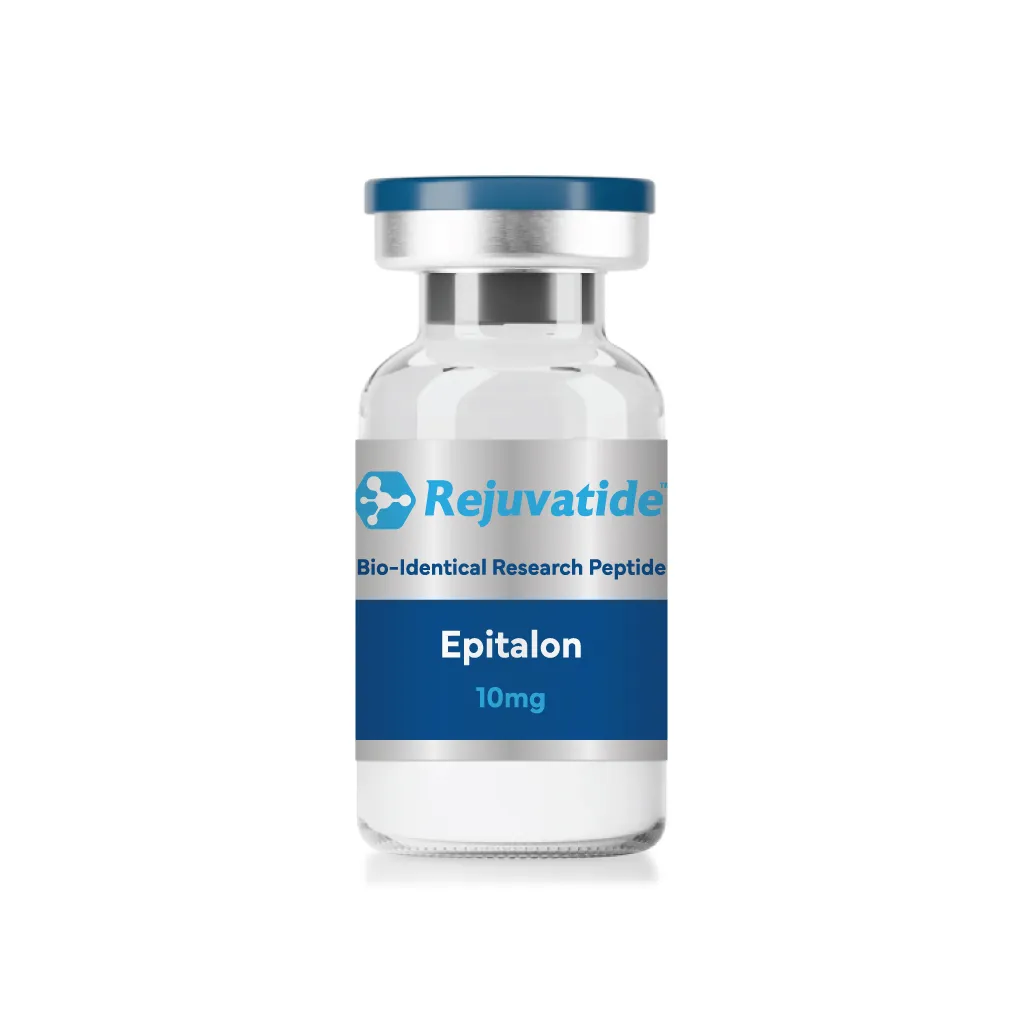
Epithalon (also spelled Epitalon) is a synthetic tetrapeptide (Ala–Glu–Asp–Gly) originally developed as an analog of the natural pineal peptide extract Epithalamin.[4,9] It has been investigated primarily in Eastern European and Russian research programs for its potential geroprotective properties, with a focus on telomerase activation, telomere maintenance, circadian regulation, and antioxidant defense.[1–4,9] Most of the evidence comes from in-vitro experiments, animal studies, and small or regionally conducted human trials. Larger, modern randomized clinical trials are still lacking, and Epithalon remains an experimental research peptide, not an approved therapeutic.[2,4,22] (PMC)
Preclinical Evidence
In human cell culture, Epithalon has been shown to induce telomerase activity and elongate telomeres in somatic cells, extending their replicative potential beyond the usual limit and maintaining more youthful morphology in vitro.[1,2,11] (PubMed) In animal models, pineal peptides (Epithalamin) and synthetic Epithalon have been studied for effects on:
- Lifespan and aging biomarkers in rodents and fruit flies[6,7,9,10] (ScienceDirect)
- Tumor incidence and carcinogenesis in chemically induced cancer models[7,9,24] (Semantic Scholar)
- Antioxidant status and oxidative damage in tissues[3,9,26] (ScienceDirect)
More recent work has also evaluated Epithalon in wound healing and retinal injury models, where it has been reported to improve healing dynamics and reduce oxidative stress in vitro.[8,10] (Wikipedia)
Emerging Human Interest
Human data are limited and often derived from older, small-scale studies with Epithalamin (pineal peptide extract) and/or Epithalon:
- In elderly subjects with accelerated cardiovascular aging, long-term courses of pineal peptides were associated with reduced cardiovascular mortality and improved long-term prognosis compared with controls.[3,8,30] (PubMed)
- In senescent rhesus monkeys, Epithalon increased evening melatonin levels and normalized circadian cortisol rhythms, suggesting a regulatory effect on neuroendocrine function.[5] (PubMed)
Some rodent studies reported lifespan extension or delayed age-related changes, while others found improved biomarkers without significant changes in mean life span, underscoring the heterogeneous and still inconclusive nature of the data.[6,7] (ScienceDirect)
Important Considerations
- Regulatory status: Epithalon is not approved as a drug by major regulatory agencies (e.g., FDA, EMA). It is sold as a research-use-only compound intended for laboratory and preclinical work.[4,8,22] (PMC)
- Evidence base: Most studies are preclinical or small-scale; robust, modern randomized human trials are lacking.[2,4] (PMC)
- Theoretical risks: Because Epithalon can activate telomerase in human cells, there is theoretical concern about cancer risk, as telomerase is also active in many tumors.[1,2,4,19,22] (PubMed)
- Use context: Current interest is primarily within basic aging biology, telomere research, and neuroendocrine regulation, not established clinical practice.
Key Research Themes (Preclinical)
Across in-vitro, animal, and limited human research, Epithalon has been investigated for its potential to:
- Activate telomerase and maintain or lengthen telomeres in somatic cells[1,2,11] (PubMed)
- Modulate circadian rhythms, especially melatonin and cortisol secretion in aged organisms[5,9,21] (PubMed)
- Provide antioxidant protection and reduce oxidative damage in tissues[3,9,26] (ScienceDirect)
- Influence gene expression related to stress response, DNA repair, and chromatin structure[1,4,9,27] (PMC)
- Affect immune parameters and age-related changes in immune function[1,3,9] (PubMed)
- Alter outcomes in models of tumor growth and carcinogenesis[7,9,24] (Semantic Scholar)
- Support wound healing and tissue repair in ocular and vascular models[8,10,26] (Wikipedia)
These findings are experimental and do not establish clinical efficacy.
Scientific Overview
Understanding Epithalon 10mg
Epithalon is a synthetic tetrapeptide with the amino acid sequence Ala–Glu–Asp–Gly and molecular formula C₁₄H₂₂N₄O₉.[4,8] (Wikipedia) It was developed by Vladimir Khavinson and colleagues as a defined analog of Epithalamin, a complex extract from the pineal gland used in early gerontology studies.[1,9] The 10 mg Epithalon vial is typically supplied as a lyophilized (freeze-dried) powder designed for laboratory reconstitution and use in controlled experimental settings.
Mechanisms of Action
Telomerase and Telomere Biology
One of the most studied aspects of Epithalon is its effect on telomerase, the enzyme that helps maintain telomere length:
- In human somatic cells in culture, Epithalon induced expression of the telomerase catalytic subunit, increased telomerase activity, and elongated telomeres, leading to additional cell divisions beyond the normal replicative limit.[1,11] (PubMed)
- More recent work has confirmed telomere lengthening in human cell lines, suggesting both telomerase-dependent and potentially alternative lengthening (ALT) mechanisms.[2,11] (PMC)
These findings have driven interest in Epithalon as a tool compound in telomere and cellular aging research.
Neuroendocrine and Circadian Regulation
Epithalon is closely linked to pineal gland biology:
- In aged rhesus monkeys, Epithalon administration stimulated evening melatonin synthesis and normalized circadian cortisol rhythms, indicating a regulatory action on neuroendocrine output.[5] (PubMed)
- Pineal peptide preparations (Epithalamin) in elderly humans have been associated with improved neuroimmunoendocrine parameters and favorable long-term outcomes in aging cohorts.[3,8,18,25] (PubMed)
These results underpin ongoing research into Epithalon’s role in circadian rhythm, sleep biology, and age-related endocrine decline.
Antioxidant and Mitochondrial Support
Pineal peptides, including Epithalon, have been reported to exhibit strong antioxidant properties:
- Studies in rodents have shown that epithalamin and Epithalon can reduce lipid peroxidation, enhance antioxidant enzyme activity, and improve overall redox balance.[3,26] (ScienceDirect)
- An in-vitro model of delayed wound healing in diabetic retinopathy demonstrated that Epitalon reduced oxidative stress and improved regenerative responses in retinal cells.[8,10] (Wikipedia)
Because mitochondria are a major source and target of reactive oxygen species, these findings have prompted further work on Epithalon as a mitochondria-relevant antioxidant tool in aging research.
Gene Expression and Chromatin Remodeling
Epithalon has been implicated in broader gene-regulatory effects:
- Experimental work suggests it can interact with promoter regions of DNA and influence the expression of genes linked to stress response, DNA repair, and circadian regulation.[1,4,25,27] (Karger Publishers)
- Pineal peptides have been associated with changes in chromatin structure, including heterochromatin decondensation in aging cells, potentially re-activating silenced genes relevant to cellular maintenance.[4,9,27] (Karger Publishers)
These observations remain mechanistic hypotheses, and their direct relevance to clinical outcomes is not yet established.
Immune and Oncologic Research Signals
Several lines of research have examined Epithalamin/Epithalon in the context of immune aging and cancer biology:
- Long-term pineal peptide courses in elderly subjects have been associated with improved immune markers and reduced incidence of certain age-related pathologies, although study designs and sample sizes vary.[3,8,18] (PubMed)
- In rodent models, Epithalon and related peptides have shown modulation of spontaneous tumor development and chemically induced carcinogenesis, sometimes with reduced tumor incidence or delayed onset.[7,9,24] (Semantic Scholar)
These results are exploratory and do not justify clinical use in oncology; they primarily support Epithalon’s role as a probe in cancer-and aging-related research.
Chemical Properties and Laboratory Handling
- Peptide type: Synthetic tetrapeptide (Ala–Glu–Asp–Gly)[4,8] (Wikipedia)
- Molecular formula: C₁₄H₂₂N₄O₉[4,8] (Wikipedia)
- Form: Lyophilized (freeze-dried) powder in 10 mg vials
- Typical storage (unreconstituted):
- Long-term: –20°C, protected from light and moisture
- Short term: 2–8°C for limited durations, according to institutional SOPs
- After reconstitution:
- Stored at 2–8°C
- Minimize freeze–thaw cycles and exposure to air to reduce oxidation and degradation
Exact storage and handling should follow the manufacturer’s certificate of analysis (CoA) and laboratory quality guidelines. Research Use Only: This Epithalon 10 mg product is intended exclusively for laboratory research. It is not approved for human or veterinary use, ingestion, or injection, and is not intended to diagnose, treat, cure, or prevent any disease.
References (Numbered as Cited Above)
- Khavinson VK, Bondarev IE, Butyugov AA. Epithalon peptide induces telomerase activity and telomere elongation in human somatic cells. Bull Exp Biol Med. 2003;135(6):590–592. (PubMed)
- Al-Dulaimi S, Thomas R, Matta S, Roberts T. Epitalon increases telomere length in human cell lines through telomerase upregulation or ALT activity. Biogerontology. 2025. (PMC)
- Kozina LS, Arutyunyan AV, Khavinson VK. Antioxidant properties of geroprotective peptides of the pineal gland. Arch Gerontol Geriatr. 2007;44(3):273–282. (ScienceDirect)
- Araj SK, Brzezik J, Mądra-Gackowska K, Szeleszczuk Ł. Overview of Epitalon—Highly Bioactive Pineal Tetrapeptide with Promising Properties. Int J Mol Sci. 2025. (PMC)
- Goncharova ND, Khavinson VK. Regulatory effect of Epithalon on production of melatonin and cortisol in senescent monkeys. Neuro Endocrinol Lett. 2001;22(4):255–263. (PubMed)
- Anisimov VN, Khavinson VK. Pineal peptide preparation epithalamin prolongs lifespan of fruit flies, mice and rats. Mech Ageing Dev. 1998;103(1–2):123–132. (ScienceDirect)
- Anisimov VN, Khavinson VK, Popovich IG, Zabezhinski MA. Effect of Epitalon on biomarkers of aging, life span and spontaneous tumor incidence in female Swiss-derived SHR mice. Mech Ageing Dev. 2003;124(8–9):1011–1023. (PubMed)
- Korkushko OV, et al. Geroprotective effect of epithalamine (pineal gland peptide preparation) on elderly subjects with accelerated aging. (Randomized comparative study on cardiovascular prognosis). (PubMed)
- Khavinson VK. Peptides and ageing. Neuro Endocrinol Lett. 2002;23(Suppl 3):11–144. (PubMed)
- Gatta M, Dovizio M, Milillo C, Ruggieri AG, Sallese M. The antioxidant tetrapeptide Epitalon enhances delayed wound healing in an in vitro model of diabetic retinopathy. Stem Cell Rev Rep. 2025. (Wikipedia)
- Khavinson VK, Linkova NS.Effect of Epitalon on telomerase activity, telomere length, and proliferative potential of human somatic cells. In: Peptide Regulation of Gene Expression (Karger). 2005. (Karger Publishers)
Frequently Asked Questions About Epithalon
What is Epithalon?
Epithalon (also spelled Epitalon) is a synthetic tetrapeptide composed of four amino acids: Ala-Glu-Asp-Gly. It was developed as an analog of Epithalamin, a natural extract from the pineal gland, and has been studied primarily for its potential effects on telomerase activity and cellular aging in research settings.
How does Epithalon work in research?
In laboratory studies, Epithalon has been shown to stimulate telomerase activity in human somatic cells. Telomerase is an enzyme that helps maintain telomere length, which are protective caps at the ends of chromosomes. Research suggests this mechanism may influence cellular replication and aging processes.
What is the purity of this Epithalon product?
Our Epithalon 10mg is supplied as a high-purity lyophilized (freeze-dried) powder, manufactured under strict quality control standards for laboratory research use.
How should Epithalon be stored?
For optimal stability, store lyophilized Epithalon at -20°C. Once reconstituted, it should be stored at 2-8°C and used within a reasonable timeframe to maintain peptide integrity.
Is Epithalon approved for human use?
No. Epithalon is sold strictly as a research-use-only compound and is not approved by the FDA or other regulatory agencies for human therapeutic use. All findings referenced are experimental and do not establish clinical efficacy.
Reviews
There are no reviews yet.